




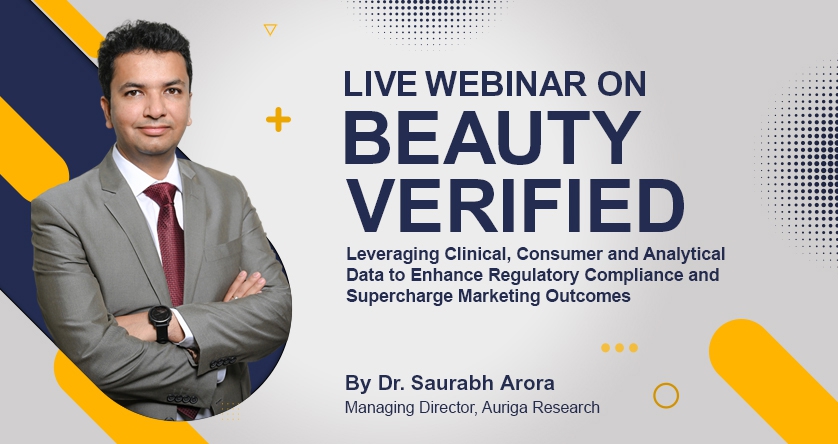
The “Beauty Verified” webinar, hosted by Auriga Research and led by Dr. Saurabh Arora, drew over 100 industry professionals — formulators, brand managers, regulatory teams, and marketing leads — for a deep, practical conversation on one of the most consequential topics in modern beauty marketing: how to substantiate cosmetic claims in an era when consumers, regulators, and digital platforms all demand evidence rather than marketing copy.
This article is a structured recap of the webinar. It captures the regulatory pressure brands now face, the science behind modern claim substantiation, the tools used to measure efficacy, and the practical action plan Dr. Arora laid out for brand managers, product developers, and marketing teams. The full video recording is embedded below.
Watch the Full Webinar
Why Skincare Tech Talk Is Losing Its Charm
The opening theme of the webinar was the shifting consumer mindset. The era of “nano liposomal retinol hydrogel” as a marketing claim is ending. Consumers want to know what a product actually does for them — and they want to know it in plain language they can verify.
The new winning structure is simple:
- Specific, measurable benefit rather than ingredient complexity
- Clear timeline rather than vague long-term promise
- Independently testable result rather than internal claim
So “reduces fine lines in 2 weeks” lands. “Proprietary peptide complex with multi-vector skin signalling” does not.
This shift is not just about communication style — it directly forces brands to substantiate what they say. A brand that claims “48-hour hydration” needs to be able to show a clinical or consumer study that demonstrates 48-hour hydration. A brand that claims “wrinkle reduction in 2 weeks” needs the corneometer or Cutometer data to back it up.
The Regulatory Reality
Cosmetic claim substantiation is no longer a marketing best-practice — it is a legal requirement across every major market. Dr. Arora highlighted the converging regulatory pressure:
- India — The Drugs and Cosmetics Act, 1940 prohibits misleading claims, and the Advertising Standards Council of India (ASCI) is actively enforcing standards through its complaints and review process. The new Cosmetic Rules, 2020 under CDSCO add further compliance obligations.
- European Union — The European Commission’s Cosmetic Products Regulation (1223/2009) and the dedicated Common Criteria for cosmetic claims demand documented, scientifically valid substantiation for every claim made on a product.
- United States — The FDA expects scientific proof for any claim that crosses the line into drug-claim territory, and the Federal Trade Commission (FTC) actively pursues dishonest cosmetic advertising as deceptive marketing under federal law.
- Digital platforms — In a major shift over the last few years, platforms like Facebook (Meta), Google, and Amazon now require study documentation before approving beauty advertisements at scale. A brand without substantiation is increasingly a brand without paid distribution.
For Indian and global brands alike, this means a single common standard: claims must be backed by documented, defensible studies — and the brands that adopt this discipline gain an asymmetric advantage over those that don’t.
The Marketing Goldmine — Why Verified Claims Sell Better
Substantiation is not a compliance cost. It is a marketing asset. Dr. Arora cited the consistent finding across consumer research that:
- Specific verified claims outperform generic claims. “48-hour hydration” beats “deep hydration” in conversion testing.
- Dermatologist endorsement significantly boosts credibility. Even at parity claims, dermatologist-validated products see better consumer trust scores.
- Independent third-party data carries more weight than internal product testing — particularly for premium and clinical-positioning brands.
- Modern consumers prioritise efficacy over brand loyalty. They will switch brands readily when they see better evidence-backed performance from a competitor.
The combination of regulatory pressure (you have to substantiate) and consumer pull (substantiation drives sales) makes this one of the highest-leverage operational decisions for cosmetic brands today.
How Cosmetic Claims Are Validated — The Three Approaches
The webinar laid out the three core methodologies for substantiation, each with different strengths:
1. Consumer Studies
Real-world product use, with structured survey-based feedback collection.
- Strengths: larger sample sizes, real-world usage conditions, natural application patterns, suitable for sensorial and perception claims.
- Limitations: less controlled environment, subjective measurement, weaker for hard-science efficacy claims.
2. Clinical Studies
Lab-based, dermatologist-supervised, instrument-measured efficacy testing.
- Strengths: scientifically rigorous, instrumental measurement, controlled conditions, regulator-accepted, defensible against FTC/ASCI challenges.
- Limitations: smaller sample sizes, higher per-subject cost, longer protocols.
3. Analytical Testing
Direct laboratory analysis of ingredient composition, contaminants, and finished-product chemistry.
- Strengths: batch-by-batch verification, supports “free-from” claims (paraben-free, sulphate-free, formaldehyde-free), heavy-metal compliance, label accuracy.
- Limitations: doesn’t measure clinical or consumer-perceived efficacy directly.
The strongest brand programmes combine all three — analytical for compliance and “free-from” claims, clinical for efficacy claims, and consumer for sensory and overall satisfaction claims.
Claim Categories and the Tools That Measure Them
A core part of the webinar was the practical mapping of claim types to validated measurement tools. The following table summarises Dr. Arora’s framework.
| Claim Type | Measurement Tool | Example Claims |
|---|---|---|
| Hydration | Corneometer | ”48-hour hydration”, “natural glow”, “instant moisturisation” |
| Anti-aging | Cutometer | ”Wrinkle reduction in 2 weeks”, “improved skin elasticity”, “firms skin” |
| Brightening | Mexameter, 3D imaging | ”Dark spot reduction”, “even skin tone”, “uniform complexion” |
| Oil control | Sebumeter, Clarity 3D | ”Controls oil for 8 hours”, “reduces acne in 7 days”, “matte finish” |
| Barrier repair | Tewameter | ”Locks in moisture”, “reduced trans-epidermal water loss” |
Each of these instruments is well-validated, with established measurement protocols, reference subjects, and publication histories that regulators and consumer-protection bodies recognise. A claim backed by Corneometer data on 30 subjects across a 48-hour timeline is dramatically more defensible than the same claim backed by internal opinion.
The Clarity Research 3D AI System
A highlight of the webinar was the introduction of the Clarity Research 3D AI System — an advanced skin imaging technology used in modern claim-substantiation studies. Key capabilities:
- 180+ skin parameters captured per subject in a single imaging session
- Polarised light from multiple angles for high-resolution surface and sub-surface skin characterisation
- 3D facial reconstruction showing pore depth, wrinkle dimension, and skin texture in volumetric detail
- Day 0 vs. Day 60 comparisons for longitudinal efficacy studies
- Detection of unexpected secondary benefits — products often produce measurable improvements in adjacent skin parameters that the original brief did not target, opening up additional claim opportunities
For brands moving from generic to specific verified claims, technology like Clarity 3D is what makes “wrinkle reduction in 2 weeks” measurable and defensible at the level a regulator or platform reviewer will accept.
Hair Care Claims
Hair care claims have the additional challenge of needing to demonstrate immediate visible results — consumers expect to see change in the first wash, not in 12 weeks. Dr. Arora outlined the testing infrastructure for hair claims:
- Hair growth and repair — Dermlite imaging for follicle and shaft analysis
- Frizz control and shine — instrumental and panel-based assessment
- Dandruff reduction — clinical assessment with controlled scalp imaging
- Sweat and odour control — environmental chamber testing
The minimum study duration recommended for credible hair-growth claims is 4 weeks, with longer studies (8–12 weeks) producing more compelling regulatory-grade evidence.
Clean Beauty and “Free From” Claims
This was one of the most discussed topics in the webinar Q&A. The key takeaways:
- Test every production batch. A clean ingredient list does not guarantee a clean finished product. Cross-contamination from shared manufacturing equipment is a real and documented risk.
- PFAS detection in lipsticks is an emerging concern globally — perfluorinated chemicals can migrate from manufacturing surfaces or packaging into finished cosmetic products.
- Formaldehyde-releasing preservatives can produce above-limit formaldehyde even when the finished-product label declares only safe-sounding INCI names.
- Vegan and animal-free claims can be objectively verified using real-time PCR (qPCR) to detect any animal-derived DNA in the finished product. This is not theoretical — qPCR-based vegan certification is now an industry-accepted methodology.
The lesson: “free-from” claims must be backed by analytical verification of every batch, not just by an ingredient declaration.
Auriga Research’s Capabilities
Auriga Research operates as an end-to-end testing partner for cosmetic brands across the lifecycle. The webinar highlighted:
- 40+ years of industry experience through Auriga and the broader Arbro Group
- 1,000+ expert staff across analytical, microbiological, clinical, and regulatory disciplines
- 8 advanced laboratories including dedicated cosmetic facilities in Delhi, Gurugram, Bangalore, and Baddi
- 2 manufacturing facilities (Arbro Pharma) for formulation development support
- Service scope: formulation development · safety and efficacy testing · clinical claim substantiation studies · regulatory consulting · ongoing batch testing
For cosmetic brands looking for a single partner across substantiation, compliance, and ongoing batch testing, this integrated capability is one of the most efficient ways to operationalise an evidence-based claims strategy.
Action Plan for Brands
The webinar closed with a practical action plan, broken down by role.
For Brand Managers
- Audit existing claims for substantiation. Identify which claims have current valid documentation and which do not.
- Invest in clinical studies for the high-stakes claims that drive premium positioning.
- Reframe consumer messaging around clear, specific, measurable benefits — not ingredient complexity.
- Design long-term efficacy studies to support recurring-use and lifetime-benefit claims.
For Product Developers
- Plan claims at product conception — not as a marketing afterthought. Build the substantiation strategy into the brief, the formulation choices, and the clinical study design from day one.
- Budget for testing expenses as a core development cost, not a discretionary line item.
- Use AI-based testing technologies like Clarity 3D where they add measurement depth that traditional methods cannot match.
- Investigate secondary benefits — products often perform better than the original brief targeted, and these adjacent benefits can become powerful additional claims.
For Marketing Teams
- Lead with measurable results. “Hydrates for 48 hours” beats “deep hydration” in every conversion test.
- Use specific claims with timeline anchors. Specificity converts.
- Feature dermatologist validation where available — it consistently increases credibility.
- Include study citations in advertising copy where regulations allow. Verifiable backing converts at higher rates than unbacked claims.
Frequently Asked Questions from the Webinar
How can a 48-hour moisturising claim be valid when consumers wash their faces every 8–12 hours? The 48-hour claim refers to the product’s ability to restore and maintain measurable hydration parameters after a single application, even through normal washing cycles, until the next application. The substantiation typically combines instrumental (Corneometer) measurement at controlled time points with consumer assessment, in study designs that explicitly account for normal wash cycles.
For paraben-free claims — is it enough to check the ingredient list, or does the finished product need to be tested? The finished product must be tested. An ingredient list confirms what was added intentionally, but cannot exclude contamination risk from shared manufacturing equipment, packaging migration, or supplier-side errors. Industry best practice is batch-by-batch analytical verification.
What’s the right study duration for hair-growth claims? Minimum 4 weeks for early visible results; longer studies of 8–12 weeks produce dramatically more compelling and regulator-accepted evidence. For premium positioning and platform-advertising approval, longer is usually worth the investment.
Clinical vs. consumer studies — which one should we prioritise? Both, in different roles. Clinical studies provide superior regulatory weight and are essential for efficacy and substantiated benefit claims. Consumer studies provide larger-sample real-world data that supports sensorial and acceptability claims. The strongest brand programmes use both.
Are these substantiation programmes affordable for small brands? Yes — scalable solutions are available. Smaller brands can start with analytical testing for “free-from” and compliance claims, then add targeted consumer studies for sensorial claims, and progressively introduce clinical studies for the highest-priority efficacy claims as the brand grows. Auriga Research designs studies at scale ranges that suit emerging brands and global brands alike.
Why test for free-from claims if the ingredient list is clean? Because contamination risks are real — cross-contamination from shared manufacturing lines, packaging migration, and supplier-side issues all introduce contaminants that ingredient declarations don’t capture. Free-from claims that aren’t backed by analytical verification are exposed to recall and regulatory risk.
Will the PIA (Product Information Application) standard expand for cosmetics? The trend across major markets is toward more demanding documentation. Brands operating internationally should plan for stricter PIA-equivalent dossier requirements over the medium term and build their substantiation programmes accordingly.
Can raw-material claims be carried directly to finished-product claims? No, in general. Raw-material efficacy data establishes potential, but finished-product claims require finished-product substantiation — the form, concentration, delivery system, and other ingredients in the formulation all affect how the active performs in the consumer’s hand.
Conclusion — Evidence Is the New Marketing
The “Beauty Verified” webinar made a clear, practical case: cosmetic marketing is shifting from claim copy to claim evidence. Regulators, digital platforms, and consumers are all converging on the same expectation. Brands that build substantiation discipline into their development and marketing process — pairing clinical, consumer, and analytical testing — gain regulatory protection, marketing leverage, and consumer trust simultaneously.
Auriga Research operates NABL-accredited cosmetic testing laboratories with full capabilities across analytical chemistry, clinical efficacy studies, consumer studies, formulation development, and regulatory consulting. Reports are issued under ISO/IEC 17025:2017 accreditation and accepted by CDSCO, BIS, ASCI, and major international markets and digital platforms.
Want to build a substantiation programme for your cosmetic brand? Request a quote or explore our cosmetics testing services.
Dr. Saurabh Arora
Auriga Research is India's largest NABL-accredited testing network with laboratories in Delhi, Manesar, Bangalore, Baddi, and Bahadurgarh. Our team of scientists delivers accurate, regulatory-accepted results across pharmaceutical, food, water, environmental, and specialised testing.
About Auriga Research →