













Particle Size Analysis | Malvern Mastersizer 3000 | Auriga Research
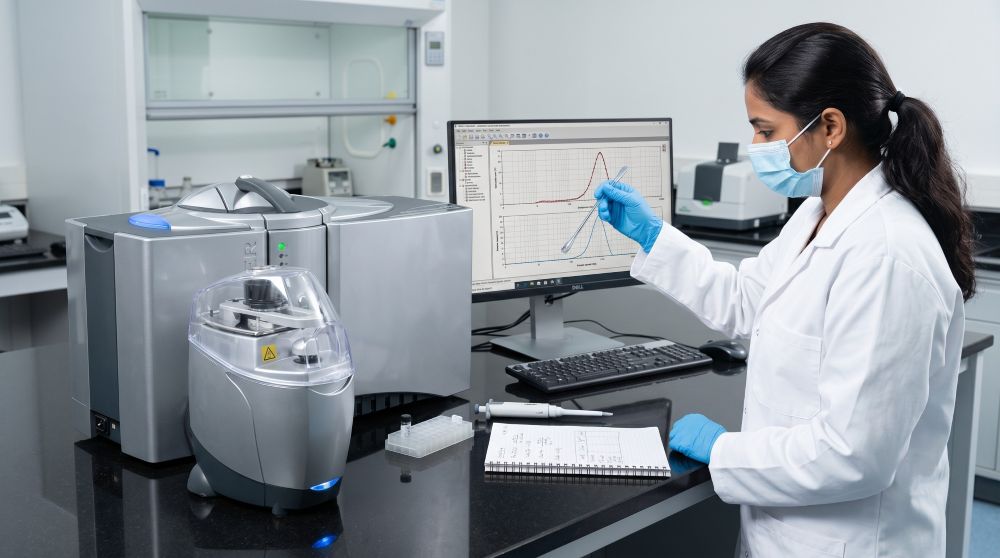
Particle size is a critical quality attribute (CQA) in pharmaceutical manufacturing per ICH Q6A — directly influencing dissolution rate, bioavailability, content uniformity, flowability, and aerodynamic behaviour of drug products. Auriga Research operates Malvern Mastersizer 3000 laser diffraction analysers, covering a measurement range of 0.01 to 3500 microns in a single platform, with wet (Hydro) and dry (Aero) dispersion modules.
The Mastersizer 3000 delivers rapid, reproducible particle size distribution measurements for APIs, excipients, granules, suspensions, emulsions, dry powder inhaler blends, and finished formulations. Reporting follows USP 429 (Light Diffraction Measurement of Particle Size) and ISO 13320 (Particle size analysis — laser diffraction methods) with D10, D50 (median), D90, span, specific surface area, and full volume-weighted distribution profiles. Sieve analysis per USP 786 is available as a companion technique for coarse-powder characterisation where laser diffraction is unsuitable.
All measurements follow validated methods with system suitability verification using NIST-traceable certified reference standards. Method development and ICH Q2(R2) validation are performed in-house. Reports are formatted against USP 429, ISO 13320, and the relevant pharmacopoeial monograph — supporting formulation development, process validation, batch release, and regulatory dossier work.
Malvern Mastersizer 3000 Laser Diffraction
Malvern Mastersizer 3000 laser diffraction analysers — the industry-standard research-grade platform for pharmaceutical particle sizing. Measurement range 0.01 to 3500 microns in a single platform. Both wet (Hydro) and dry (Aero) dispersion modules available — covering APIs, excipients, suspensions, emulsions, dry powder inhaler blends, and finished formulations.
Six Particle Size Analysis Services
Each card maps the service to the analytical method and the governing regulatory or pharmacopoeial reference.
Particle Size Distribution by Laser Diffraction
Particle size distribution by laser diffraction on the Malvern Mastersizer 3000 across 0.01 to 3500 microns per USP 429 and ISO 13320.
D10 D50 D90 Reporting for APIs & Excipients
Quantitative D10, D50 (median), D90, span, and full volume-weighted distribution reporting against product specifications. Standard CQA deliverable for ICH Q6A submissions.
Wet Dispersion for Suspensions & Emulsions
Hydro wet-dispersion module for suspensions, emulsions, and water- or solvent-dispersible APIs. Sub-micron resolution with stable refractive-index-matched dispersion.
Dry Dispersion for Powders & Granules
Aero dry-dispersion module for free-flowing powders, dry powder inhaler blends, hygroscopic excipients, and coarse granules. Variable pressure for friable-particle preservation.
Particle Size as Part of Stability Protocol
Stability-linked particle size monitoring across ICH Q1A(R2) accelerated and long-term time points. Detects particle growth, agglomeration, and Ostwald ripening in suspensions and emulsions.
Method Development & Validation
Custom particle size method development and ICH Q2(R2) validation — specificity, accuracy, repeatability, intermediate precision, and robustness, with a full validation report.
Project Timelines
Indicative TAT from sample receipt. Confirm exact timeline with your SPOC at quote stage based on dispersion mode, sample queue, and reporting requirements.
| Service Type | Turnaround Time |
|---|---|
| Standard Particle Size Analysis (laser diffraction) | 3 to 5 business days |
| Rush Particle Size Analysis (established method) | 1 to 2 business days |
| Sieve Analysis (USP 786) | 3 to 5 business days |
| Method Development + ICH Q2(R2) Validation | 2 to 3 weeks |
| Stability-Linked PSD Monitoring | Per ICH stability protocol |
How It Works
Get a Quote
Share your material type, dispersion medium, and whether you need wet or dry analysis. Your SPOC confirms sample quantity and D10, D50, D90 reporting requirements.
Collect and Send Your Sample
Prepare per SPOC instructions at quote stage. Each sample is bar coded and registered in YLIMS on receipt.
Testing and QA Review
Your sample is tested under validated, documented methods. Results pass through formal QA review including instrument log check, reference standard verification, and analyst sign-off.
Receive Your Test Report
Your report is delivered digitally within the committed TAT, formatted for CDSCO, USFDA, and regulatory submission. Track status via YLIMS.
Who Needs Particle Size Analysis
- API manufacturers requiring particle size data for dissolution prediction and bioavailability optimisation.
- Pharma formulators characterising excipient particle size for blend uniformity and compressibility.
- Inhalation product developers requiring aerodynamic characterisation of dry powder inhaler (DPI) blends.
- CDMO clients requiring particle size as a critical quality attribute (CQA) in dossier submissions per ICH Q6A.
- Suspension and emulsion product owners monitoring particle size during stability studies for Ostwald ripening or agglomeration.
- Nasal spray, ophthalmic, and topical product developers needing particle size for product performance characterisation.
- Generic developers preparing ANDA submissions requiring D10/D50/D90 specifications matched against the reference listed drug.
- QC and stability teams tracking PSD changes across ICH Q1A(R2) accelerated and long-term time points.
Why Auriga for Particle Size Analysis
Malvern Mastersizer 3000 Laser Diffraction
Malvern Mastersizer 3000 — the industry-standard research-grade laser diffractometer for pharmaceutical particle sizing. Range 0.01 to 3500 microns covers APIs, excipients, and suspensions.
USFDA Inspected Facility
Particle-size testing is performed at a USFDA Inspected facility — data is accepted in USFDA dossier submissions without re-testing.
Wet (Hydro) + Dry (Aero) Both Available
Both wet (Hydro) and dry (Aero) dispersion modules are in scope. Your SPOC confirms the appropriate mode at quote stage based on your material chemistry and dispersion behaviour.
ICH Q6A CQA-Grade Reporting
Reports formatted as critical quality attribute (CQA) submissions per ICH Q6A. D10, D50, D90, span, and full distribution against product specification — ready for CTD Module 3 inclusion.
Submission-Ready Documentation
Reports formatted against USP 429 and ISO 13320 with chain-of-custody and method-validation evidence — routinely accepted for CDSCO, USFDA, EMA, and PMDA submissions. Particle size is outside our NABL scope, so reports are issued as non-NABL test reports.
ICH Q2(R2) Method Development & Validation
Custom particle size method development and validation per ICH Q2(R2) — specificity, accuracy, repeatability, intermediate precision, and robustness with full validation report.
5+
NABL Accredited Labs
5 Cities
Pan-India Lab Network
12,000+
Clients Served
1985
Arbro Group · Auriga Research
Regulatory References
- • USP <429> — Light Diffraction Measurement of Particle Size.
- • ISO 13320 — Particle size analysis — Laser diffraction methods.
- • USP <786> — Particle Size Distribution Estimation by Analytical Sieving.
- • ICH Q6A — Specifications including particle size as a Critical Quality Attribute (CQA).
- • ICH Q2(R2) — Validation of Analytical Procedures (March 2024).
Accreditation Scope
Auriga Research is a NABL accredited laboratory (ISO/IEC 17025:2017). Particle size analysis by laser diffraction is not within our NABL accredited scope, so these reports are issued as non-NABL test reports — performed under validated methods at a USFDA Inspected facility and formatted against USP 429 and ISO 13320. If your submission requires a NABL-scope report for particle size, raise it with your SPOC at quote stage.